






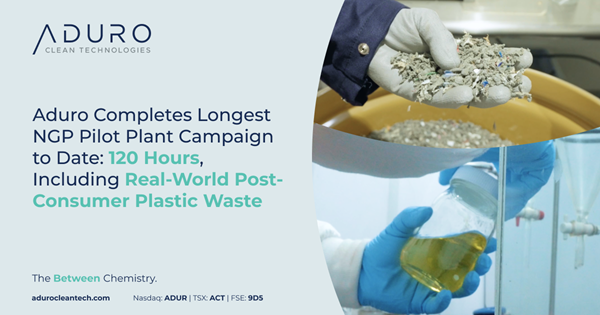
Aduro Completes Longest NGP Pilot Plant Campaign to Date: 120 Hours, Including Real-World Post-Consumer Plastic Waste
Extended campaign demonstrates feedstock flexibility, process stability and operating continuity while generating engineering and permitting data for the FOAK Facility at Chemelot
Aduro Clean Technologies Inc. a clean technology company using the power of chemistry to transform lower value feedstocks, like waste plastics, heavy bitumen, and renewable oils, into resources for the 21st century, today provided an update on continued operating progress at its Next Generation Process (“NGP”) Pilot Plant.
The latest NGP campaign ran for approximately 120 hours over a period of five days, the longest reported to date, and marked further progress in the NGP program’s transition from controlled feedstock testing to processing real-world post-consumer plastic waste. During the campaign, the Pilot Plant transitioned from processing controlled polyethylene (“PE”)/polypropylene (“PP”) blends to PO95, a post-consumer plastic-waste agglomerate sourced from the Netherlands containing at least 95% polyolefins, principally PE and PP, while evaluating feedstock flexibility, process stability and operating continuity under changing conditions. The campaign achieved condensable hydrocarbon yields of approximately 85%, in line with its performance target, while prioritizing operating flexibility rather than yield or product-quality optimization. With different feedstocks, operating conditions, and testing objectives, the September and October campaigns were designed to evaluate distinct aspects of process performance and are therefore not directly comparable.
The NGP Pilot Plant plays a central role in advancing Aduro’s Hydrochemolytic Technology (“HCT”) toward industrial deployment. Through a series of structured operating campaigns, the Company is evaluating how the integrated process responds to different feedstocks, operating parameters, and conditions. Each campaign is designed around specific technical objectives, and the resulting data used to refine equipment, controls and operating procedures while establishing and building the technical basis for scale-up.
Commercial plastic-waste streams are rarely uniform, and their composition can change over time as collection practices, sorting processes and market requirements evolve. Industrial recycling facilities must therefore accommodate both variations in feedstock composition and longer-term changes in available waste streams, while managing residual contaminants and operating disruptions. The October campaign evaluated these practical requirements by testing the ability of the NGP system to transition between feedstocks, respond to interruptions and maintain operation without a complete shutdown. These capabilities are important to plant availability and operating economics at industrial scale. The growing body of technical findings and operating experience from successive NGP campaigns is informing equipment selection, process controls, and operating procedures for the First-of-a-Kind (“FOAK”) Plant at Chemelot, where engineering and permitting activities are underway.
Highlights
- Longest reported NGP campaign: The Pilot Plant completed approximately 120 hours of operation over five days, 60% longer than the 75-hour campaign reported in September.
- Multiple feedstock transitions: The campaign began with a 50:50 PE/PP blend, transitioned to an 80:20 PE/PP blend, then to post-consumer PO95 feedstock for approximately 20 hours, before returning to the 80:20 PE/PP blend, all without a complete process shutdown.
- Post-consumer recycled feedstock: PO95 is a commercially available post-consumer waste-plastic agglomerate containing at least 95% polyolefins, principally PE and PP. The material sourced from the Netherlands contained approximately 1.5% polyethylene terephthalate (“PET”) 1.2% polyamide (“PA”), and up to 1% polystyrene (“PS”), together with fillers, additives and other residual constituents characteristic of post-consumer waste plastics. Processing this material extends NGP testing beyond controlled PE/PP blends to an established grade of post-consumer waste-plastic feedstock.
- Operating resilience: Planned interruption tests were performed with each feedstock type, with the Operations team successfully restoring target operating conditions without a complete shutdown. The campaign also experienced an unexpected short-duration power outage from the local utility, during which backup systems engaged and the Pilot Plant continued operating.
- Condensable hydrocarbon recovery: The campaign achieved approximately 85% condensable hydrocarbon yield, meeting its performance target. Operating conditions were selected to evaluate feedstock transitions, process stability, and operating continuity, rather than to maximize hydrocarbon yield.
- Wastewater data for FOAK development: A representative wastewater sample collected during processing of PO95 will undergo detailed characterization to inform wastewater treatment system design and support environmental permitting for the FOAK Facility.
The October campaign builds on the September NGP campaign, which evaluated three controlled PE/PP feed compositions over 75 hours and reported condensable hydrocarbon yields ranging from 88.8% to 90.8%. While September focused on performance across controlled feedstock compositions, October extended operating duration and shifted the emphasis toward feedstock flexibility, process stability, and operating continuity, including the introduction of post-consumer recyclate. Together, these campaigns reflect the structured approach of the NGP program, with successive tests designed to build a more complete understanding of process performance, operating characteristics, and the requirements for industrial scale-up.
The introduction of PO95 represents an important progression in the NGP testing program. In the European plastics recycling industry, PO95 is a recognized designation for recycled-plastic agglomerate containing at least 95% polyolefins, principally PE and PP. Unlike the controlled blends used in earlier campaigns, this post-consumer material is more representative of feedstocks commonly processed by the recycling industry and contains residual constituents associated with collection, sorting, and recycling processes. These constituents introduce additional considerations for process control, hydrocarbon recovery, and product characteristics. Processing this feedstock provides operating experience with materials more representative of those being evaluated for the FOAK Plant at Chemelot.
The campaign also evaluated the response of the integrated NGP system to planned and unplanned operating disruptions. Controlled interruption tests were performed with each feedstock type to assess process response, controls, and operating procedures. Following each test, the Operations team restored target operating conditions without a complete shutdown. During an unexpected utility power outage, backup systems engaged and maintained Pilot Plant operation. These experiences provide practical information on operating resilience, backup systems, process controls, and operating procedures for larger-scale operation. These capabilities are important to maintaining plant availability and, in turn, supporting operating economics at industrial scale.
The October campaign included the collection of a representative wastewater sample during processing of PO95 to support FOAK Facility development at Chemelot. A representative sample collected during processing of PO95 will undergo detailed characterization to inform wastewater treatment system design and support the environmental permitting process. Ebert HERA B.V., engaged by Aduro to lead civil and environmental permitting, is advancing this workstream alongside the FOAK Early Works engineering and procurement activities being undertaken by Saipem S.p.A. Operating information from the NGP program continues to provide inputs for the industrial design as these activities progress.
“We continue to make progress in transitioning from cleaner, controlled feedstocks to processing genuine post-consumer plastic waste,” said Ofer Vicus, Chief Executive Officer at Aduro. “The data generated through these campaigns are helping us better understand how HCT performs under conditions representative of industrial applications, while also allowing us to validate and refine our approach to different markets. Scale-up is not defined by yield and process performance alone. It also requires understanding the characteristics of available feedstocks and the operating requirements of specific geographic markets and industrial sites. The NGP Pilot Plant is providing the practical knowledge needed to make those decisions as we advance the FOAK Plant at Chemelot and prepare for future industrial deployment.”
“Each campaign is strengthening the operating team’s understanding of the relationships between feedstock composition, process response and the adjustments needed to maintain stable operation,” said David Weizenbach, Chief Operating Officer at Aduro. “The operators are learning to recognize those changes earlier, respond more effectively and restore the process to the appropriate operating range. We capture those lessons in our SOPs, controls and operating practices and then apply them in the next campaign. That accumulation of practical operating experience is an important part of preparing for larger-scale operation.”
Aduro will continue its structured NGP testing program through additional campaigns evaluating different feedstocks, operating parameters, and process conditions. Findings from successive campaigns will be used to refine process controls, equipment configuration and operating procedures while expanding the technical dataset supporting ongoing FOAK engineering, project development, and future industrial deployment of HCT.
#Adurocleantech #modernplasticsnetwork #printmagazine #printpublication #modernplasticsglobal #modernplasticsindia